
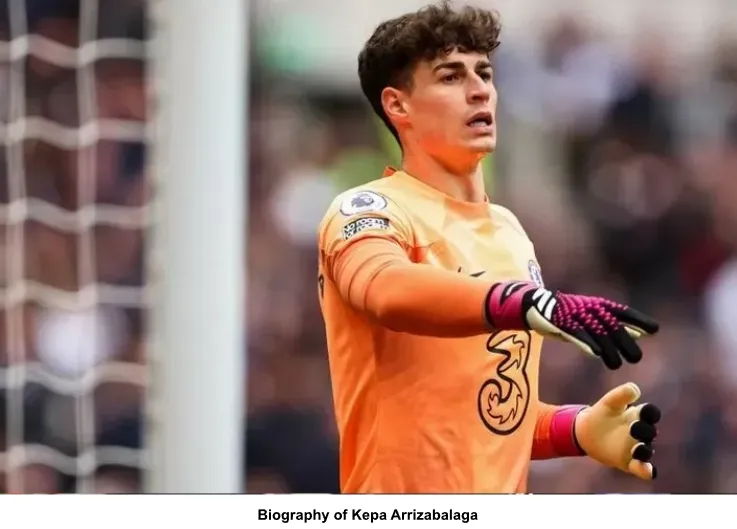
According to Goaldaddy, Kepa Arrizabalaga Revuelta’s career is a paradox of valuation. He remains, to this day, the most expensive goalkeeper in football history, a distinction he earned in 2018 when Chelsea triggered his £71.6 million release clause. Yet for much of the seven years that followed, he was judged as a player who could never justify that fee. The comparison that defines Kepa is not between him and his peers, but between the price he commanded and the role he ultimately accepted. His biography is the story of a goalkeeper who had to lose his status to find his level, and who emerged not as a world-record signing, but as something arguably more useful: a reliable, title-winning squad goalkeeper.
The Athletic Education and the Record-Breaking Leap
Kepa was born on 3 October 1994 in Ondarroa, a coastal town in the Basque Country, and joined Athletic Bilbao’s academy at the age of ten. His path to the first team was not immediate. He progressed through the farm team, Basconia, and the reserve side, Bilbao Athletic, before loan spells at Ponferradina in the third tier and Real Valladolid in the second. Those loans were formative rather than glamorous, and they shaped a goalkeeper whose game was built on shot-stopping and composure rather than sweeping or aerial dominance.
By 2016, he had established himself as Athletic’s first-choice goalkeeper, and his performances attracted attention from Real Madrid. A move to the Bernabéu collapsed, and in August 2018, Chelsea intervened. Thibaut Courtois had forced his exit to Madrid, Alisson had chosen Liverpool, and Chelsea, in desperation, paid Kepa’s full release clause. The comparison with Courtois was immediate and unavoidable. Courtois was a towering, commanding presence; Kepa was smaller, more agile, and a different kind of goalkeeper entirely. The fee made him a symbol of a transfer strategy driven by necessity rather than conviction.
Chelsea: The Record, the Wobble, and the Victim Narrative
Kepa’s Chelsea career produced 163 appearances across five seasons, and the honours were genuine: the Europa League in 2019, the Champions League in 2021, the UEFA Super Cup, and the Club World Cup. His finest moment came in the 2021 Super Cup against Villarreal, when he was brought on specifically for the penalty shootout and saved two spot-kicks to secure the trophy. He also received the award for the best save in the Premier League in 2022–23.
See more: https://goaldaddy.io/ตารางคะแนนฟุตบอล/
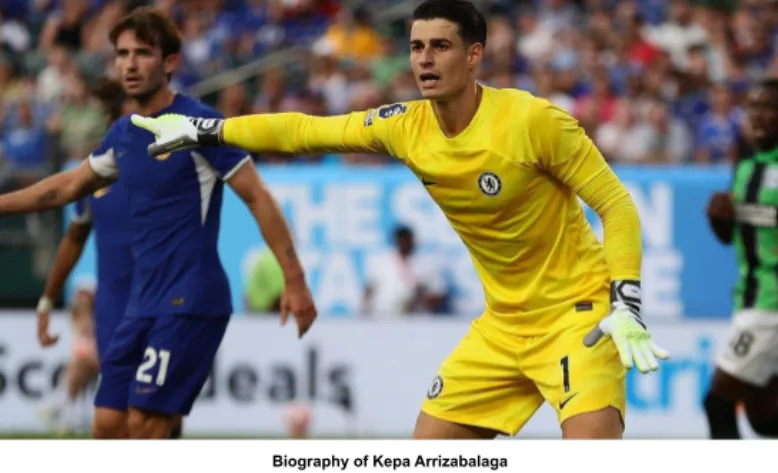
Yet the statistical record tells a more complicated story. Across 109 Premier League appearances for Chelsea, he kept 35 clean sheets and conceded 129 goals, with 255 saves. In the 2022–23 campaign, his save percentage fell to 54.5 percent, the worst single-season figure in Premier League history at the time. The BBC’s assessment was blunt: Kepa “was a victim of his £71m price tag,” a goalkeeper who “was never seen to be one who would command a world record transfer fee”. The comparison that mattered was not between Kepa and other goalkeepers, but between Kepa and the financial and symbolic weight attached to his transfer.
The Loan Years: Madrid’s Deputy and Bournemouth’s Revival
The two seasons that followed were an exercise in recalibration. In 2023–24, Kepa joined Real Madrid on loan as cover for the injured Courtois—the man he had replaced at Chelsea five years earlier. The irony was sharp, but the role was clear. He made 20 appearances across all competitions, winning La Liga and the Champions League, but an adductor injury allowed Andriy Lunin to seize the starting position, and Kepa returned to the bench.
The following season, on loan at Bournemouth, he found something closer to a home. He made 35 appearances in all competitions, kept nine clean sheets, and helped the Cherries to the sixth-best defensive record in the Premier League. The comparison between Kepa at Chelsea and Kepa at Bournemouth is not one of quality but of context. Freed from the expectation of being a record signing, he became a reliable, unspectacular No. 1—a goalkeeper whose shot-stopping and distribution were functional rather than transformative.
The Arsenal Move and the Raya Comparison
In July 2025, Kepa joined Arsenal for £5 million, a fee that represented a 93 percent depreciation on the world-record sum Chelsea had paid seven years earlier. The comparison that followed was immediate: Kepa versus David Raya, the established Spanish No. 1 at the Emirates. The analytical data offered a nuanced verdict. In their respective recent seasons, Kepa had a slightly higher save percentage (72.7 percent to 69.3 percent) and a better pass completion rate (74.1 percent to 70.7 percent), though the disparity in matches played made the comparison almost negligible.
The more instructive comparison was stylistic. Both are Spanish goalkeepers comfortable in possession, but Raya is the more aggressive sweeper and the more established organizer of a back line. Kepa, by contrast, arrived as depth—an experienced, title-winning deputy who could provide competition without destabilizing the hierarchy. At thirty-one, with thirteen Spain caps and a Nations League winner’s medal, he had become something he had never been at Chelsea: a low-risk, high-experience squad option.
Conclusion: The Value of No Longer Being the Story
Kepa Arrizabalaga’s biography is not the story of a goalkeeper who justified a world-record fee. It is the story of a goalkeeper who survived one. The comparisons that have defined him—to Courtois, to Raya, to the price tag itself—all point toward the same conclusion: Kepa was never the goalkeeper his fee demanded, but he was always a better goalkeeper than his reputation allowed. At Chelsea, he was a symbol of a transfer mistake; at Real Madrid and Bournemouth, he was a professional who did his job; at Arsenal, he is a deputy whose experience outweighs his limitations. The world’s most expensive goalkeeper has spent seven years learning that value is not measured in pounds. It is measured in the quiet reliability of being ready when called upon—and in the unlikely contentment of no longer being the story.

I am Amelia 35-year-old expert blogger and SEO specialist with a passion for crafting engaging, high-quality content. With years of experience in digital marketing and writing, I blend creativity with strategy to help websites grow. My work reflects insight, authenticity, and a love for connecting ideas through words.


