
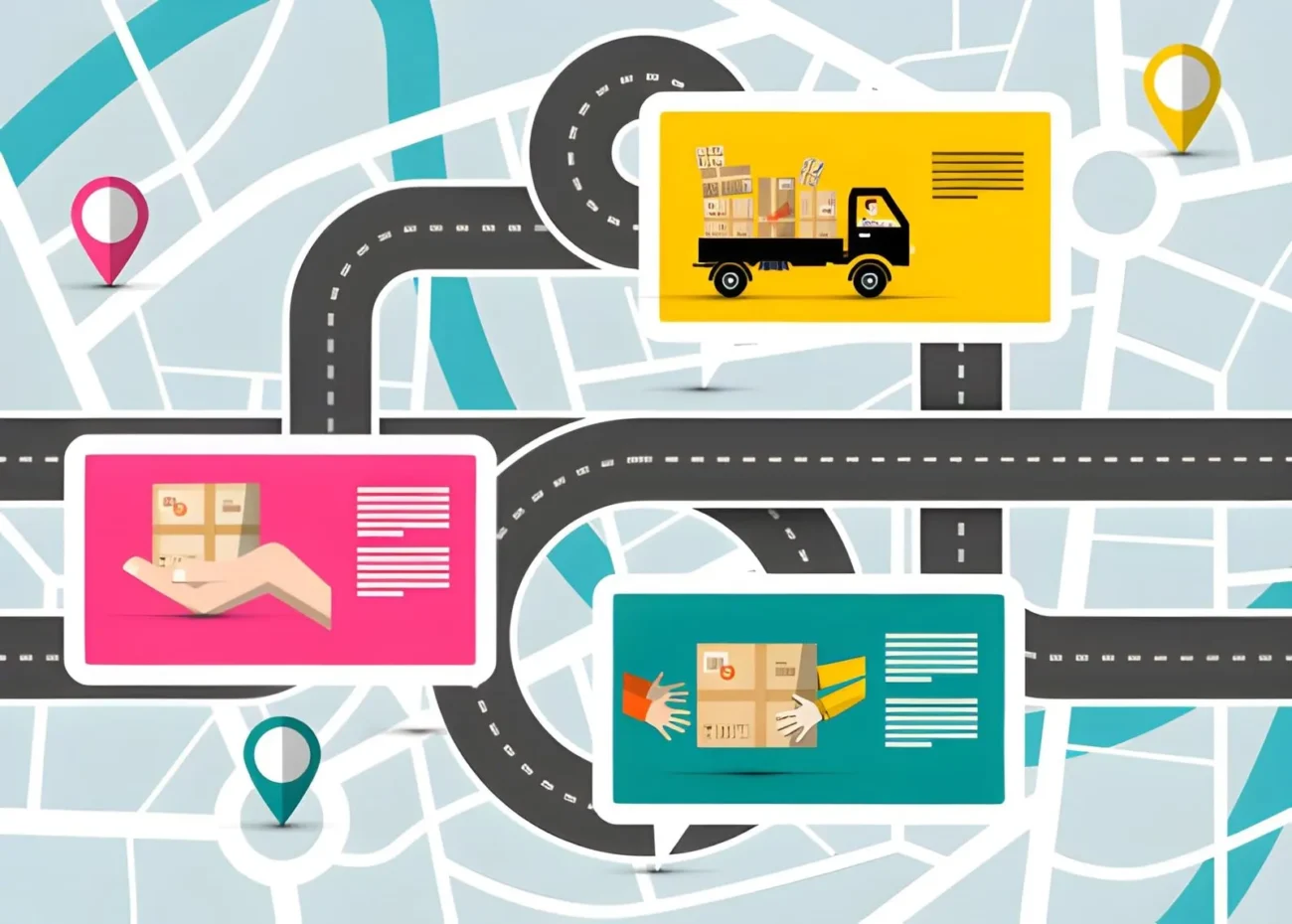
A route that looks efficient on a map can collapse the moment a driver hits the road. Sequencing dozens of stops seems like a sorting problem until real-world constraints enter the equation. Delivery windows, vehicle capacity, driver hours, and traffic all reshape the order that actually works.
Optimize for distance alone, and you miss a time window, overload a van, or push a driver into overtime. A route planner for multiple stops weighs these variables together, not one at a time. It turns scattered addresses into a sequence that survives dispatch instead of unraveling by the third stop.
Let’s examine how a route planner for multiple stops builds routes around genuine operational limits.
Why Does the Shortest Route Rarely Win?
Distance is one input among many. A geographically tight loop often violates a delivery window or exhausts driver hours.
- A nearby stop with a strict morning slot must move earlier, breaking proximity order.
- Two-person or install deliveries add dwell time that ripples across every later ETA.
- Low-emission zones and truck bans erase paths that looked shortest on the map.
- Traffic patterns shift the true cost of a segment by the hour, not the mile.
- Failed-delivery reattempts insert unplanned stops that a pure distance model ignores.
Route optimization software prioritizes feasibility over raw mileage. The most practical sequence protects customer promises while using capacity efficiently. This distinction separates real logistics planning from simple point-to-point navigation apps.
What Industries Depend Most on Multi-stop Route Planning?
Some delivery models feel constraint pressure sooner and harder than others. Density, service requirements, and delivery windows drive that intensity.
- Grocery and cold chain combine tight slots with temperature and freshness limits.
- Retail and e-commerce manage volume spikes, returns, and customer-selected windows.
- Healthcare and pharma carry compliance rules and time-critical shipments.
- Big and bulky delivery demands install time, two-person crews, and appointment control.
- Courier and 3PL networks juggle high parcel density against narrow margins.
Each model benefits when a route planner for multiple stops enforces its specific rules. A capacity-aware, window-aware sequence keeps promises that manual planning routinely breaks. The heavier the constraint load, the larger the operational payoff from automation.
How Does a Route Planner For Multiple Stops Re-sequence Mid-shift?
Morning plans decay fast. Traffic, cancellations, urgent orders, and driver absences all invalidate the original sequence. Dynamic route optimization recalculates only the affected stops while protecting stable commitments.
| Disruption | Planner Response | Protected Outcome |
| Sudden Traffic Delay | Reorders downstream stops | On-time windows preserved |
| Urgent Same-day Order | Inserts stop into nearest feasible route | No full rebuild required |
| Driver No-show | Redistributes stops across roster | Balanced workloads maintained |
| Extended Service Time | Shifts later ETAs and notifies customers | Accurate delivery expectations |
A route planner for multiple stops sends revised assignments straight to the driver app. This prevents crews from following outdated sequences after conditions change. Real-time visibility turns disruption into a managed event rather than a cascade of missed stops.
What Constraints Does a Route Planner For Multiple Stops Actually Handle?
A capable planner treats each constraint as a hard rule or a flexible objective. Hard rules cannot be broken: objectives guide optimization while allowing controlled trade-offs.
| Constraint Type | Examples | Effect on Sequencing |
| Capacity Limits | Weight, volume, pallet count, refrigeration | Caps stops per vehicle before overloading |
| Time Windows | Appointment slots, business hours, curfews | Forces earlier or later positioning of stops |
| Driver Rules | Shift length, mandated breaks, licensing | Limits route duration and total workload |
| Vehicle Profile | Height, axle weight, zone access | Removes restricted roads from the path |
| Service Time | Unloading, install, signature capture | Extends dwell time and shifts later ETAs |
A route planner for multiple stops evaluates all five categories at once. Manual dispatchers using spreadsheets and fixed maps cannot hold this many variables together. That gap widens as order density and service-level agreements grow more demanding.
Which KPIs Improve With Constraint-aware Multi-stop Routing?
Smart sequencing shows up across cost, productivity, and service metrics. Distance saved is only the visible surface of deeper gains.
- Cost per delivery drops as consolidation cuts vehicles and empty miles.
- Stops per route rises when capacity and time windows align cleanly.
- First-attempt delivery rate climbs through feasibility checks before dispatch.
- ETA accuracy improves once service times reflect real completion data.
- On-time in-full (OTIF) strengthens as windows drive the sequence logic.
- Emissions per delivery fall alongside reduced backtracking and idle time.
A route planner for multiple stops connects these outcomes to one decision layer. Fleet route optimization balances demand against capacity rather than simply adding vehicles. That efficiency compounds across every delivery cycle and every operating territory.
How to Choose a Route Planner For Multiple Stops?
Evaluation should start with the operating model, not a generic feature checklist. The right platform models the conditions that decide whether a route is genuinely executable.
| Evaluation Area | Question to Ask |
| Constraint Depth | Does it model capacity, windows, skills, and driver hours together? |
| Dynamic Routing | Can it re-sequence stops and reassign drivers after dispatch? |
| Fleet Flexibility | Does it coordinate owned, gig, and outsourced vehicles? |
| Scalability | Does planning stay fast across thousands of stops and multiple hubs? |
| Service-time Learning | Does completed delivery data refine future stop durations? |
| Integrations | Does it connect to TMS, OMS, WMS, telematics, and carrier systems? |
| Visibility | Does it surface ETA drift, long halts, and missed stops in one view? |
A route planner for multiple stops should adapt during execution, not only before it. Prioritize platforms that treat routing as a continuous cycle across planning, dispatch, and learning. Point tools that only produce a morning stop list leave value unclaimed.
How do you Implement Multi-stop Route Planning Successfully?
Software delivers results only when the rollout respects data, drivers, and operating reality. A staged approach beats a full switch every time.
- Clean your data first. Fix addresses, order dimensions, and service-time estimates before automating, since bad inputs weaken every downstream sequence.
- Define constraints with dispatchers. Capture real vehicle limits, driver rules, and delivery windows from the people who route daily.
- Pilot one hub, then scale. Prove the KPIs on a single territory before rolling the planner across your full network.
- Separate hard rules from objectives. Mark what cannot break versus what can flex, so the planner optimizes without producing unusable routes.
- Train crews on exceptions, not just routes. Drivers who understand re-sequencing and proof capture protect first-attempt success during disruption.
- Review planned versus actual weekly. Feed completed-route data back so service times, capacity assumptions, and future sequences keep improving.
A route planner for multiple stops rewards operators who treat setup as an operating discipline, not a one-time install. The teams that clean data early and pilot deliberately reach reliable routes faster than those that switch everything at once.
Route Every Stop With Confidence, Starting Today
A route planner for multiple stops turns tangled delivery demand into sequences that survive real conditions. It weighs capacity, windows, driver hours, and traffic as one connected decision. The result protects service commitments while controlling cost across every route.
Manual methods cannot balance this many moving variables at enterprise scale. Teams that pair constraint-aware routing with technology partners such as FarEye plan faster and recover from disruption sooner. Treat routing as a continuous discipline rather than a fixed morning task.
That shift separates fleets that absorb disruption from fleets that quietly pay for it every single day.

I am Amelia 35-year-old expert blogger and SEO specialist with a passion for crafting engaging, high-quality content. With years of experience in digital marketing and writing, I blend creativity with strategy to help websites grow. My work reflects insight, authenticity, and a love for connecting ideas through words.


